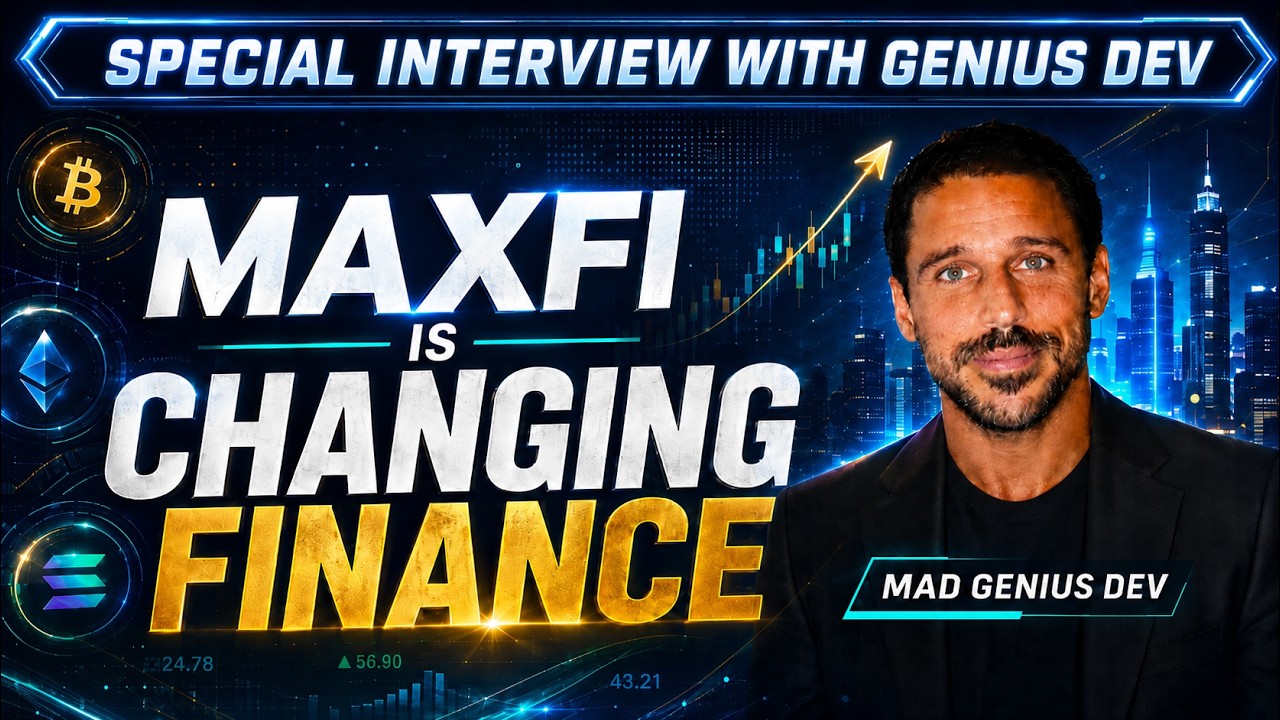
Be the House: LP Farming Explained, and the No-Swap Architecture That Keeps It Safe (Blockchain Pill AMA)
Alex 'YaBonks' Walch and DAO King join Alex from Blockchain Pill to explain liquidity provisioning from the ground up for an ICP audience — what LP farming actually is, why 95% of traders lose while market makers get paid either way, and the two architecture decisions (no swaps, no pooled funds) that give MaxFi one of the smallest attack surfaces Valves Security says it has ever reviewed. Plus the Snuggle rebalancing walkthrough, the rebalance-delay trick that realizes zero impermanent loss, and why tokenized stocks on Robinhood Chain are paying what they're paying.
Chapters
- 0:00Meet the team behind MaxFi Labs
- 1:31DAO King on ICP, the bottom, and crypto spring
- 3:48From zero to $3.5M TVL in five months
- 5:54What has been done to prevent hacks
- 9:09No-swap architecture: 70–80% of exploits happen during swaps
- 10:22No pooled funds: your position lives on the DEX
- 11:52Valves Security, 42 internal audit rounds, white hats
- 12:42Public founder, single owner, and why masks hurt DeFi
- 14:34Why a built-in swap was left out on purpose
- 17:47What LP farming actually is
- 20:00Concentrated liquidity and the concentration factor
- 22:09The five hidden costs of traditional rebalancing
- 26:18Snuggle rebalancing, drawn out by hand
- 28:17The rebalance delay and realizing zero impermanent loss
- 30:00It's not a Ponzi — you're a market maker like Jane Street
- 31:5695% of traders lose. Be the house.
- 36:20Portfolio allocation: 80% blue chip, and the meme sleeve
- 38:38Tokenized stocks and the Apple position
- 40:07Robinhood Chain: 8th largest protocol, 11th in DeFi
Key Takeaways
- ✓MaxFi went from zero to roughly $3.5 million in TVL in five months, through a bear market, and is now the 8th largest protocol on all of Robinhood Chain — ahead of PancakeSwap, Curve, SushiSwap and Symbiosis — and, at the time of recording, the 11th largest liquidity manager in all of DeFi. Alex's explanation for it is one line: capital flows to the most capital efficient systems, and as soon as somebody realizes that, they tell all their friends.
- ✓Be the house. About 95% of traders lose money and roughly 97% of meme coin traders do, while the market makers on the other side of those trades get paid whether price goes up, down or sideways — and carry far less risk than anyone trying to time entries. It's DAO King's framing, and the team liked it enough to adopt it as a slogan on the spot. DeFi is the first time retail can take that side of the table, with $5 or $100 rather than institutional size.
- ✓Traditional rebalancing costs you five separate things every time it fires: the swap fee on half your principal, slippage, price impact, MEV extraction, and — the big one — realized impermanent loss. Snuggle rebalancing removes the swap entirely by repositioning the range one tick space from the current price and letting the AMM bring price back, cutting impermanent loss 40–50% per rebalance.
- ✓The rebalance delay is the second lever, and it can realize *zero* impermanent loss. Price wicks out of range on a news event and comes back two hours later — with a 4- or 24-hour delay set, no rebalance ever fired, so nothing was realized. You stopped earning for a couple of hours and that's the entire cost. Older systems rebalance instantly because they charge a fee on your principal each time they do it.
- ✓Roughly 70–80% of DeFi exploits happen during a swap transaction. So MaxFi and Snuggle were built with a no-swap architecture — there is no place in the smart contracts where a swap occurs. Convenience features like zap-in were deliberately left out because they would have required one. You swap on Uniswap or wherever you like, then bring your tokens over.
- ✓The second architecture decision is no pooled funds. Most protocols put everyone's money in one pot, which becomes one big target — it's how bridges and large vaults get drained. On MaxFi every position is individually owned and lives on the DEX itself. Deposit $100 and that $100 passes through the smart contract onto the exchange as your own position. There is no communal pot to drain.
- ✓Valves Security, the third-party firm that completed the most recent audit round, said they had never seen a protocol so secure with such a small attack surface. That sits on top of 42 rounds of internal audits and half a dozen independent white hat hackers who found nothing user-fund affecting.
- ✓Alex owns and controls the contracts, alone, and is public about it deliberately. His view: the anonymous-founder-in-a-mask culture is part of why trust in DeFi is so low, and developers who build in public move the whole industry toward maturity faster. You can email, text or call him.
- ✓The tokenized stock pools on Robinhood Chain are the open window right now — Apple, Nvidia, the S&P 500 held as liquidity pairs, paying 100–600% because MaxFi arrived as one of the first market makers to an asset class that is weeks old. Equities are far less volatile than crypto, and volatility is the input to impermanent loss, so a low-volatility pair with heavy fee flow is close to an ideal setup. DAO King holds over $20,000 in Apple/USDG at 200–400%. Those rates come down as liquidity arrives, which is exactly why the window is worth using while it is open.
Zero to 11th Largest in DeFi in Five Months
Start with the number, because it's the reason this interview happened at all.
Five months after launch, MaxFi is the 11th largest liquidity manager in all of DeFi, and the 8th largest protocol on the entirety of Robinhood Chain:
"We are currently the 8th largest protocol on all of Robinhood Chain right now. Of all the thousands of protocols on Robinhood already, we're the 8th largest. We're bigger than PancakeSwap. We're bigger than Curve. We're bigger than SushiSwap. We're bigger than Symbiosis."
Roughly $3.5 million in TVL, from zero, through a bear market, over a stretch when other DeFi protocols were being drained for hundreds of millions of dollars. The TVL grew anyway.
And the newest pools are paying accordingly. Tokenized stocks on Robinhood Chain — Apple, Nvidia, the S&P 500, held as liquidity pairs — have been running 100–600%, because MaxFi showed up as one of the first market makers to an asset class that is weeks old.
None of that comes from a token emission or a yield gimmick. It's swap fees: the same revenue Jane Street and Goldman Sachs collect for making markets, split among whoever supplied the liquidity. What follows is the whole conversation — what LP farming actually is, why 95% of traders lose while the people quoting them prices get paid either way, and how the rates got to where they are.
Meeting the Team, on an ICP Channel
Alex from Blockchain Pill hosted Alex "YaBonks" Walch and DAO King (Aaron) for a full introduction to MaxFi — aimed squarely at an audience that knows the Internet Computer well and concentrated liquidity not at all. He'd posted a screenshot a few days earlier showing the APR he was getting on the platform, the comments filled up with where is this money coming from, and this conversation is the answer to that question.
It's worth saying up front that the host and the founder share a first name, which made for a running joke throughout the recording. Where this article says Alex without qualification, it means Alex "YaBonks" Walch, the founder and developer of MaxFi and Snuggle.
The host's own starting point is the useful one, because it's most people's:
"I'm no expert in DeFi, but I was looking at ways to be able to make more money... whenever the ICP price drops, everybody says this is a blessing, you can now buy more ICP. But then people ask — with what? I put all my money into ICP at $4, then at $3, now it's at $2. I'm out of money."
That's the problem LP farming addresses. Not predicting the bottom, but generating something to buy the bottom with.
Be the House
DAO King took the framing question head-on — the is this a Ponzi question that fills comment sections whenever a high APR screenshot circulates:
"It's not a Ponzi. It's actual fees. You're actually a market maker like a Jane Street."
Then the statistics, and they're brutal in the way everyone half-knows and mostly ignores. Around 95% of traders lose money. After roughly six months, about 70% have blown up their accounts entirely. For meme coin traders specifically, the figure is closer to 97%.
Alex's own history is the same story:
"I've been trading for a long time and it was just like I was treading water. I couldn't really get ahead. I'd make money and then a couple weeks later I'd lose money... And what I realized was the traders as a whole are collectively always losing money, and the market makers are always making money. The house always wins."
DAO King's answer became a slogan on the spot:
"Be the house."
The structural point underneath it:
"The market makers earn money whether the traders win or lose. They don't care if the price goes up, they don't care if the price goes down, they don't care if the price goes sideways. They make money the whole time, and they have much less risk compared to somebody trying to time the market and day trade or swing trade."
That side of the table used to require being Jane Street or Goldman Sachs. DeFi is the first time it's open to anyone with $100 and the willingness to learn how it works.
There's a supporting observation in there too. Hundreds of billions of dollars sit parked as liquidity across Ethereum, Solana and the rest — through a bear market. Nobody parks that kind of capital in something that doesn't pay.
What LP Farming Actually Is
So where is the money actually coming from? It's the question the host's comment section kept asking, and it's the right one to ask.
"Liquidity farming or liquidity provisioning is the best way, in my opinion, to earn the highest real yield in DeFi than any other way."
The mechanics, from the top:
A decentralized exchange holds liquidity pools, and each pool contains a pair of tokens — wrapped ETH and USDC, say. When somebody wants to buy ETH, they bring dollars, swap them into the pool, and pay a swap fee. That fee goes to whoever supplied the tokens.
Swap fees range from about 0.01% on efficient stablecoin pools to 1% on thin meme coin pools, with roughly 0.3% as the industry standard. It sounds small until you consider throughput — every dollar flowing through the pool pays it, in both directions, all day.
Alex's analogy:
"It's like earning like a stockbroker earns a commission every time somebody trades with them."
And the part that makes DeFi structurally different from traditional market making:
"People on the retail level like us, just normal everyday folks, can have a piece of that with however much money they have. They don't have to have millions of dollars like an institution does, like a Jane Street or Goldman Sachs. You could do this with $5. You could do this with $100. Whatever you have, it scales percentage-wise."
Concentration Is the Multiplier
All swap fees a pool earns are distributed proportionally to the in-range liquidity at the moment of each swap. If your position is in range when a trade happens, you earn a share.
Concentration is what turns that share into something meaningful. Going very wide across a range dilutes your earning power; concentrating into a tighter band multiplies your proportion of the fees flowing through the pool during that period.
Which sets up the actual problem:
"The trick is, with concentrated liquidity provisioning — what is the most capital-efficient way to keep your liquidity position in range earning the most amount of time with the least amount of something called impermanent loss."
The Five Hidden Costs of a Normal Rebalance
Concentrate your range and price eventually leaves it. What happens next is where most platforms quietly take your returns.
A traditional rebalancer does a 50/50 swap rebalance: the moment you're out of range, it swaps half your tokens and re-centers price in the middle of a new range. That one action costs you five separate things:
- The swap fee, charged on half your principal — 0.3% on a normal pool, up to 1% on a thin one
- Slippage between quote and fill
- Price impact from your own trade moving the pool
- MEV extraction — sandwich attacks and front-running, another fraction of a percent or more
- Realized impermanent loss, and this is the elephant
On that last one:
"When you rebalance your liquidity position, the bigger the movement of your range, the bigger the realized impermanent loss is. And over dozens of rebalances, that can really add up."
Snuggle Rebalancing, Drawn by Hand
Alex drew this one on camera with his hand as the range and a pen as the price, and it's the clearest explanation of the technique the team has put on video. The host's admission afterward is telling:
"I personally didn't get it when you first explained it to me when we talked before. I had to see it work to understand how it works."
The setup: price moves up and out of your range. You've stopped earning. Critically, you are now fully converted into one side of the pair — in a WETH/USDC position where price ran up, you're sitting entirely in USDC.
The traditional response swaps half that USDC back into WETH to re-center, paying all five costs above, and realizing the full gap as impermanent loss.
The Snuggle response:
"Instead of swapping half my USDC for wrapped ETH to get back to here and taking huge losses that most people don't realize, I just take my USDC side, I reposition the range one tick space away from the current price, and I let the AMM — the automated market maker, the DEX — move the price back into my range."
No swap. No slippage, no price impact, no MEV, no swap fee.
The geometry is worth being precise about, because it's easy to mishear. The range keeps its full configured width — a 6% range stays a 6% range. What changes is where it gets placed. A traditional rebalance drags the range's centre onto the current price. A Snuggle rebalance places the range so its near edge sits one tick space away from the current price, with the whole width extending in the direction you're already holding.
So the range travels roughly half a range-width less than it would under a re-centre, and — the larger effect — no portion of the position is sold at the adverse price to get there. That combination is where the 40–50% less realized impermanent loss per rebalance comes from.
The assumption it rests on is that price reverts to the mean:
"The natural price will always revert to the mean eventually. Only on really extended trends does it go in one direction for a while, but normally it goes and then it pulls back and then it just chills for a while."
Over dozens or hundreds of rebalances, a 40–50% reduction in the dominant cost is the difference between a strategy that works and one that doesn't.
The Rebalance Delay: Realizing Zero
The second lever is the one that can cost you nothing at all.
"Let's say the price moves out of your range and you have a 4-hour rebalance delay. Well, let's say the price moves out of your range and 2 hours later it just comes right back in your range. You didn't rebalance at all. Zero impermanent loss realized."
Alex describes it as setting traps. You earn while price is in range; when it leaves, you wait, because a large share of moves come back. Pull up any price chart and count the wicks — news events spike price and then retrace.
"Let's say there's some ETH news and ETH pumps 10%, but 24 hours later it's down 10% again, right back to where it started. If you have a 24-hour rebalance delay, you just stopped earning fees for a couple hours and you realized zero impermanent loss and you're back to earning."
The reason other platforms don't offer this is a straightforward conflict of interest:
"On older systems, they rebalance you like instantly as soon as it can, because they earn money every time they rebalance you. They take a piece of your principal actually. They charge a protocol fee on your principal on the rebalance. So they want to rebalance you instantly as fast as they can, even if it hurts you."
How to Actually Allocate
Asked for closing advice, Alex went straight to risk management rather than yield:
"Even with liquidity provisioning there is risk involved. So be smart. Don't just LP on meme coin pools."
His own allocation:
- ~80% blue chip — the core of the portfolio
- ~10% altcoin pools — VIRTUAL/WETH and similar
- 5–10% meme coin pools — spread across roughly ten positions
The meme sleeve has an explicit assumption baked in:
"If I'm looking at my meme coin allocation, 10 of the best options that I think, and I'm going to assume nine out of 10 of them are going to zero, and one might actually win."
Same discipline as not putting everything into one meme coin, since they can drop 60–90% overnight in a way that Bitcoin, ETH and Solana won't. If one hits, it pays for the whole sleeve.
And a calibration on expectations that's easy to lose sight of when 600% numbers are circulating:
"Start blue chip, and realize that if you're earning 20, 30, 40% on blue chips, that's incredible yield. And a lot of times with a capital efficient system like this, you can see 50 to 100% APRs. Not guaranteed, but depending on the situation, you can. And in some cases, we see 100 to 600% especially on the new Robinhood tokenized stocks."
The Security Question
The host opened the interview here rather than saving it for the end, and his reasoning was sound: MaxFi was holding roughly $3.5 million in TVL at the time of recording, launched into a stretch when DeFi protocols were being drained for hundreds of millions, and the TVL grew anyway. He wanted to know why anyone should be comfortable with that. It's the part to read closely before depositing anything, and the answer is more structural than most protocols are able to give.
Alex's background frames the answer. He's a senior software engineer of over 20 years, and for the last six he has been publicly auditing Solidity smart contracts on his YouTube channel — interviewing founders and picking apart contracts on-air so his audience could see the risks they were walking into. The owner can mint more tokens. This function is a rug pull. There's a re-entrancy issue here. He has been teaching that for years, and building contracts alongside it.
Snuggle itself took about 15 months, and it started as a personal problem: managing concentrated liquidity positions by hand was costing him 10+ hours a week.
The AI Argument
One point he made is counterintuitive and worth pulling out, because it cuts against the instinct that newer code is riskier:
"This was the best time in my opinion to write smart contracts if you know what you're doing, because you can then also take advantage of these AI tools that these other people are using to find exploits and holes in older protocols that were developed when these tools didn't exist."
The protocols getting exploited were largely written before this class of tooling existed. Their vulnerabilities were there the entire time; the tools that surface them arrived later. A contract written now can be run through the same analysis attackers use, before it ever ships. It costs real money in tokens to run high-quality models over a codebase repeatedly — and it buys the ability to catch an exploit vector a human reviewer would plausibly miss.
A note on this, stated plainly because the security page states it plainly too: the 42 internal rounds were conducted with AI security analysis tooling rather than traditional manual review. Valves Security is the third-party human audit.
Architecture Decision One: No Swaps
Alex analyzed the hacks the host was worried about, plus five years of prior ones, and found a dominant pattern:
"70 or 80% of the exploits happen during a swap transaction."
MEV attacks, sandwich attacks, front-running — much of it outside the smart contract's control entirely. So the architecture removed swaps altogether:
"There's no place in our smart contracts or system that we do a swap. And it's actually part of how Snuggle rebalancing works — there are no swaps involved. So I said I'm going to keep that methodology throughout the entire protocol. I'm not going to add in additional features that are just a little more convenient to zap into a position if it requires a swap."
The host had actually noticed the missing zap-in feature while using the platform and assumed it was an oversight:
"At first, when I realized that I have to do the swaps on Uniswap and then create a position, I was wondering — why didn't he integrate something like this? It sounds like something he could have integrated just to make my life easier."
The answer is that the convenience would have cost the single most exploited surface in DeFi. Alex's illustration of the stakes: swap a million dollars, get front-run, and you can be left with $200,000 without understanding what just happened. He pointed at the Jared from Subway MEV bot — a bot that sandwiched other people's transactions, and was itself eventually drained during a swap.
Architecture Decision Two: No Pooled Funds
The second target he designed out is the communal pot:
"Protocols that have a model where they pool everybody's fund into one big pot — that is one big target. And if something goes wrong with that one pooled fund, it's all gone."
MaxFi uses per-position, user-controlled management instead. Your position exists on the decentralized exchange itself:
"You create a position on MaxFi, let's say. It doesn't go in a big pooled vault where everybody's money is put in one big pot. Your position — let's say you put in $100 — that $100 goes through our smart contract and goes onto the DEX. Your position actually exists on the exchange itself. So we have all these thousands of positions, they're all individually owned by the users on the DEXes."
It's the same structural weakness behind most large bridge exploits: everything in one place. There is no communal pot here to drain.
The Audit Record
Those two decisions produce an unusually small attack surface, and the third-party auditor said as much. Valves Security, who completed the most recent audit round, told the team they had never seen a protocol so secure with such a small attack surface.
That sits on top of 42 rounds of internal audits and roughly half a dozen independent white hat hackers who have tried to break it and found nothing that affects user funds. MaxFi and Snuggle run the same smart contracts, and both security pages carry the full record.
On Being Public
Alex owns and controls the contracts — alone — and is deliberate about being identifiable:
"All of the trust and accountability and operational security is on me. And I'm out here publicly for a reason, for that trust factor. My reputation's on the line. You can reach out to me. You can text me, email me, call me."
His broader argument is about the industry rather than the protocol:
"Some people put on masks when they come on AMAs... You don't know who they are. You don't know who controls these smart contracts you're putting your money in... If we can bring a higher level of trust to the DeFi space, then I think we further this industry as a whole a lot quicker."
The host owned a past mistake here — he'd hosted masked developers a couple of years ago and took criticism for it — and thanked DAO King for standing with him at the time by wearing a mask on his own show in solidarity. Which, as DAO King pointed out, ended up getting a lot of views and probably helped the project in question.
Tokenized Stocks on Robinhood Chain
This is the newest thing on the platform and it needs one clarification immediately, because the name misleads people:
"We're not talking about Robinhood the app. Robinhood just made their own blockchain. It's called Robinhood Chain. They have an entire blockchain now, all backed and the infrastructure is all run by Robinhood itself, and they are the issuer of the tokenized stocks on the blockchain."
It rolled out within roughly the past month. Alex describes about three weeks of straight coding to get the contracts and the site deployed onto it — which bought the position at the top of this article: 8th largest protocol on the whole chain, past PancakeSwap, Curve, SushiSwap and Symbiosis, on a chain that is itself only weeks old.
DAO King's position is the concrete illustration — over $20,000 in Apple/USDG (USDG being the stablecoin on Robinhood Chain), with yields he describes in the 200–400% range while this window lasts. His reasoning for choosing Apple is worth repeating because it's a genuinely different way to pick an LP pair:
"Apple's not going anywhere. In fact, it's going higher since I bought it, because Apple buys back billions of dollars of their stock every year... So they literally have this constant buy pressure buying back their stock. And now I'm earning a yield."
He contrasts it directly with what he'd been trying before:
"I was trying to do LP farming with ICP tokens. So hard. It just bounces crazy. But with Apple stocks, no problem."
That's the real appeal of the asset class for LPs — equities are far less volatile than crypto, and volatility is the input to impermanent loss. A lower-volatility pair with high fee flow is close to an ideal setup.
His overall earnings at the time of recording: close to $10,000 a month, over $300 a day, elevated by the stock pools specifically.
Why the Rates Are What They Are
Alex is direct about the mechanism, and about the fact that it's temporary:
"We have this first mover advantage with real world assets on chain, RWAs, and we're seeing outsized returns because we're the first market makers to this brand new emerging market. So take advantage of that stuff while you can."
Few market makers, real trading volume, fees split among very few providers. As liquidity arrives, rates settle toward normal. That's not a caveat bolted on afterward — it's the actual mechanism, and understanding it is what tells you the window has an expiry.
"When something's new and you have a first mover advantage, that's when you can get really outsized returns for weeks or months before things kind of level out to regular liquidity provisioning levels."
You can currently LP the S&P 500 on MaxFi.
DAO King on ICP and Crypto Spring
The host also asked DAO King where he sees the market going — a question that matters here rather than being a digression, because liquidity conditions are the raw material LP fees are made of. His answer, condensed:
This is the wrong time to be selling ICP. The multi-DEX work is shipping, the cloud engine is live, and Caffeine AI has not yet fully rolled out its crypto infrastructure, staking, and contract functionality — so he expects a lot to land over the following two to three months. Zooming out, he framed October through December as crypto spring: liquidity increases into year-end, and altcoins need liquidity to move.
His historical framing is the part worth keeping:
"We went from 3 to 20 and then we came back down, and at one of the other times we pumped from about 2 to 9. This is not a token that can't go from 2 to 20 or 2 to 30 in the right settings with the right liquidity."
And the trader's read, from more than 20 years of it: when the reality of a project and its token price are this far out of sync, the risk-reward ratio is dislocated — and dislocations are what you buy, not what you capitulate into. None of which is financial advice, and he's holding through it himself.
Why This Keeps Growing
Alex's own explanation for going from zero to $3.5M TVL and 11th in DeFi in five months came down to three things: DAO King's marketing, the tech working, and one structural claim —
"Capital flows to the most capital efficient systems. And as soon as somebody realizes that, they tell all their friends."
What's Coming Next
Robinhood Chain is the newest venue, not the last one. The roadmap, in the order Alex is shipping it.
Robinhood Chain goes to Snuggle next. MaxFi is deliberately where new chains and interface work land first — it gets rolled out fast, debugged and dialled in with an active community beating on it, and then moves to Snuggle once it's battle tested. Most of the kinks in the Robinhood integration have been worked out here already, so it ships to Snuggle with the most blue-chip Robinhood pools found so far.
Then HyperEVM, on MaxFi. There has been large demand in the community to run Snuggle rebalancing on HYPE pools, and that's the next new chain here after Robinhood.
Then BSC, Ethereum, Avalanche and Solana.
The thing to understand about that list is that none of it changes the engine. Snuggle rebalancing, the delay, the no-swap architecture and the per-position ownership model are the same code on every one of those chains. What a new chain adds is venues — more pools, more pairs, more fee flow to be early to. The tokenized stock window on Robinhood Chain is what being first to a new venue looks like, and there are several more venues coming.
Where to Start
If this was your introduction to LP farming, the sequence is straightforward:
- Read the security page on MaxFi or Snuggle. Same contracts, full audit record, no-swap and no-pooled-funds architecture documented in detail.
- Start on a blue-chip pair. WETH/cbBTC, WETH/USDC — 20–40% is an excellent result and the risk profile is the mildest available.
- Use the presets. Aggressive, moderate and conservative range widths and rebalance delays are pre-loaded per pool. You don't need to do the math.
- Look at the tokenized stocks while the window is open. Robinhood Chain pools are paying what they're paying because MaxFi got there first, and that will not last indefinitely. HyperEVM is next, and the same first-mover dynamic applies each time.
- Keep the speculative sleeve small enough that losing it doesn't matter.
The Learn and Videos sections cover the rest — impermanent loss, range selection, correlated pairs, and the full Snuggle rebalancing mechanics — in more depth than this conversation had room for.
None of this is financial advice. APRs shown are snapshots at a moment in time and will change with trading volume, liquidity, and market conditions. Liquidity provisioning carries real risk including impermanent loss and, on speculative pairs, permanent loss of capital.
Stay ahead of the market
Get yield updates, new pool alerts, and market insights from MaxFi.
No spam. Unsubscribe anytime.
Frequently Asked Questions
Why would I want to be the house instead of trying to trade?
Because the house wins by default and the players mostly don't. Roughly 95% of traders lose money, and about 97% of meme coin traders do. A market maker gets paid whether price goes up, down or sideways, because the fee is charged on the trade itself, not on the direction — every single swap that passes through your pool pays you, and you never have to be right about where price is going. That is the seat casinos, brokerages and Wall Street market-making desks have occupied for a century, and until DeFi it was closed to anyone without institutional size. Now it isn't: $100 opens a position, fees are split proportionally so a small position earns at the same rate as a large one, and the whole thing runs without asking permission from anybody. It's the framing DAO King landed on mid-conversation, and the team liked it enough to adopt it as a slogan on the spot: 'be the house.' MaxFi went from zero to $3.5 million in TVL in five months on exactly that pitch.
What is LP farming, in plain language?
A decentralized exchange holds liquidity pools, and each pool contains a pair of tokens — WETH and USDC, for example. When somebody wants to buy ETH with dollars, they swap into that pool and pay a swap fee for the privilege. That fee goes to the people who supplied the tokens: the liquidity providers. Alex's analogy is a stockbroker earning a commission every time a client trades. You aren't predicting direction; you're being paid for providing the inventory that makes the trade possible. Swap fees run from about 0.01% on efficient stablecoin pools to 1% on thin meme coin pools, with roughly 0.3% as the industry standard. When millions of dollars flow through a pool, that 0.3% adds up, and it's split proportionally among everyone whose liquidity was in range at the moment of each swap.
Why does MaxFi make me swap somewhere else first? Wouldn't a built-in swap be more convenient?
It would, and that's exactly why it isn't there. Alex analyzed five years of DeFi exploits and found that roughly 70–80% of them happen during a swap transaction — sandwich attacks, front-running, MEV extraction, and failure modes that sit outside the smart contract's control entirely. A protocol with no swap in it cannot be attacked that way. His example: if you swap a million dollars and get front-run badly, you can walk away with a fraction of it and not understand what happened. The zap-in convenience feature would have opened the single most commonly exploited surface in DeFi for the sake of saving users one step, so it was left out on purpose. Swap on Uniswap or wherever you prefer, then bring the tokens over.
Is my money pooled with everyone else's?
No, and this is the second deliberate architecture decision. Many protocols pool all user funds into a single vault, which concentrates everything into one target — if something goes wrong with that pot, it's all gone at once. It's the pattern behind most large bridge and vault exploits. MaxFi uses per-position, user-controlled management instead. Your position exists on the decentralized exchange itself, individually owned by you. Deposit $100 and that $100 moves through the smart contract onto the DEX as your position. Thousands of positions, each separately owned, with no communal pot to drain.
What security work has actually been done, and by whom?
Three layers. First, 42 rounds of internal audits during development — Alex is a senior software engineer of 20+ years who has spent the last six years publicly auditing Solidity contracts on his YouTube channel, and he ran the codebase through extensive automated security analysis using current LLM tooling. His argument is that writing new contracts today is safer than it was: the same AI tools attackers use to find holes in older code can be pointed at your own code before it ships, and many exploited protocols were simply written before those tools existed. Second, Valves Security completed a third-party audit and remarked they had never seen a protocol so secure with such a small attack surface. Third, roughly half a dozen independent white hat hackers have attempted to break it and have not found anything user-fund affecting. The full record is on the MaxFi and Snuggle security pages — both platforms run the same smart contracts. Worth noting the internal rounds used AI security analysis tooling rather than traditional manual review, which the security page states plainly.
How does Snuggle rebalancing differ from a normal rebalance?
A traditional rebalancer does a 50/50 swap. The moment your position goes out of range, it swaps half your tokens and re-centers the price in the middle of your new range. That single action costs you five things: the swap fee on half your principal (0.3% on a normal pool, up to 1% on a thin one), slippage, price impact, MEV extraction on the swap, and the realized impermanent loss from moving your range a long distance. Snuggle rebalancing does it without a swap. When price leaves your range you're fully converted to one side of the pair anyway — so instead of swapping half of it back, the range is repositioned one tick space away from the current price on the side you're already holding, and the AMM is left to bring price back into it. Price reverts to the mean eventually; only sustained one-way trends prevent it. The range keeps its full configured width throughout — a 6% range stays a 6% range. What differs is placement: a traditional rebalance re-centres the range onto the current price, while a Snuggle rebalance puts the range's near edge one tick space from it and extends the full width in the direction you're already holding. That's roughly half a range-width less travel, and no part of the position is sold at the adverse price to get there, which together produce the roughly 50% lower realized impermanent loss per rebalance. Over dozens or hundreds of rebalances, that difference is what separates a profitable strategy from an unprofitable one.
What is the rebalance delay and why does it matter so much?
It's a timer you set before a rebalance is allowed to fire after your position goes out of range, and it's the one setting that can realize literally zero impermanent loss. Say price wicks out of your range on a news event and comes back two hours later. With a 4-hour delay, no rebalance ever happened — you stopped earning fees for two hours and that is the entire cost. Nothing was realized. Alex describes it as setting traps: you earn while price is in range, and when it leaves, you wait, because a large share of moves come back. Look at any price chart and count the wicks. Older platforms rebalance you as fast as they possibly can, because they charge a protocol fee on your principal every time they do — so instant rebalancing is in their interest even when it's against yours.
Why are the tokenized stock pools paying 100–600%?
First-mover advantage in a brand new market. Robinhood launched its own blockchain — Robinhood Chain — and is the issuer of the tokenized stocks on it. Alex spent about three weeks coding to get the contracts and site deployed there, and MaxFi is now the 8th largest protocol on the entire chain, ahead of PancakeSwap, Curve, SushiSwap and Symbiosis. When an asset class is that new, there are very few market makers providing liquidity, so the fees from the trading that does happen are split among very few providers. That's what produces the outsized rates. It's also why the rates are explicitly temporary: as more liquidity arrives, yields settle toward normal levels. DAO King holds over $20,000 in Apple/USDG and describes yields in the 200–400% range while this window is open. None of these figures are guaranteed, and they will come down.
How should a beginner allocate across pools?
Alex's own split: roughly 80% blue chip, about 10% altcoin pools, and 5–10% in meme coin pools at any time. Within the meme allocation he picks around ten of the best candidates and assumes nine go to zero and one wins — same logic as not betting everything on a single meme coin, since they can drop 60–90% overnight in a way Bitcoin, ETH and Solana will not. His point about expectations is worth internalizing: earning 20, 30 or 40% on blue-chip pairs is already an excellent result, and a capital-efficient system can push that to 50–100% depending on conditions. The 100–600% figures are specific to the new Robinhood tokenized stock pools and the first-mover window there. Start on blue chips, keep the speculative sleeve small enough that a total loss doesn't matter, and let one winner pay for the rest of that sleeve.
What did DAO King say about ICP and the current market?
His view is that this is the wrong moment to give up on ICP. He pointed to the multi-DEX work, the cloud engine, and Caffeine AI not having fully rolled out its crypto infrastructure, staking and contract functionality yet — so he expects meaningful developments over the following two to three months. On the broader market, he framed October through December as 'crypto spring,' when liquidity increases into year-end, and alts need liquidity to move. His historical note: ICP has gone from 3 to 20, and from around 2 to 9, in prior cycles — this is not a token incapable of moving several multiples given the right liquidity conditions. His trading read, from 20+ years, is that when the reality of a project and its token price are this far out of sync, the risk-reward favors accumulating rather than capitulating. Not financial advice, and he's holding through it himself.
MaxFi is only five months old. What is the case for getting in now rather than later?
The returns are biggest exactly when an asset class is new and almost nobody is making a market in it — and that window closes on its own. Robinhood launched its own chain and is issuing the tokenized stocks on it. Alex spent about three weeks writing the code to get the contracts and the site deployed there, which is why MaxFi is already the 8th largest protocol on the entire chain, ahead of PancakeSwap, Curve, SushiSwap and Symbiosis, and the 11th largest liquidity manager in all of DeFi at the time of recording — five months after launch, built by a team you can email, text or call. The 100–600% on those stock pools is simply what being early to real trading volume with very few providers looks like, and it settles as more liquidity arrives. DAO King's timing read points the same way from the other side: he expects liquidity to come back into the market from October through December. And none of it requires a call on direction. Fees start compounding the moment a position is in range, whether the market rips, dumps or chops. And the venue list is still expanding: HyperEVM is next on MaxFi after Robinhood Chain, on heavy community demand for Snuggle rebalancing on HYPE pools, with BSC, Ethereum, Avalanche and Solana behind it — each one a new set of pools to be early to. Open a blue-chip pair with $100, watch the fees land for a week, and scale in once you believe it.